Layoffs 2026: My Departure from Amazon
Sharing my experience of the day it happened, the aftermath, and the decisions to be made before walking out the door. A firsthand insight into big tech layoffs.
If you’re reading this because you just got a calendar invite titled “Org Update,” I’ve been exactly where you are.
I was caught in a recent layoff round at Amazon after six years. While I’ll dive into the mechanics of that day soon, I want to start with a brunch I had a month later. Every friend at that table worked in tech, and every one of them was terrified they’d be next. Paradoxically, I was the calmest person there. While they were spiraling through “What ifs,” I already had my answers.
I realized then that the only thing scarier than a layoff is the anticipation of one. To help take the mystery out of that transition, I’ve broken down my own experience.
Let’s talk about how it actually started.
It Started the Night Before
On Monday, October 27th, 2025—the Halloween bank holiday—the rumors started circling. Articles were popping up claiming another round of layoffs was hitting Amazon. It gets the blood pumping, sure, but I have a text exchange with a colleague where I asked, “On a scale of 1 to 10, how nervous are you?”
His response: “2.”
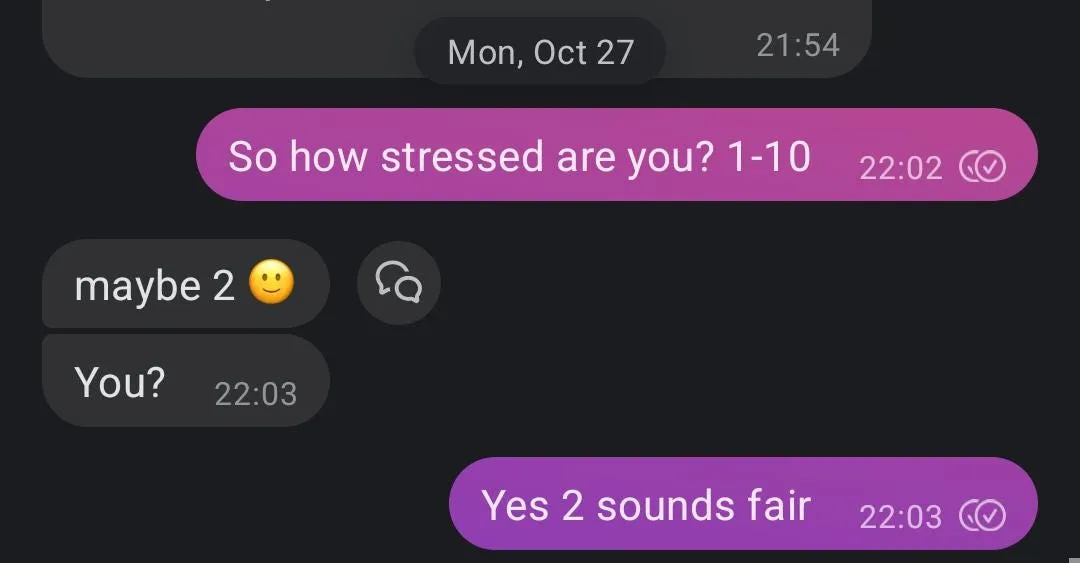
It wasn’t that we thought we were untouchable; it was just that after six years with the company, we’d survived plenty of these “rounds” before. Plus, we are a ~30-person team owning several Tier-1 services. In Amazon’s terms, if a tier-1 service goes down, the company stops functioning. With that level of job security in mind, I went to sleep peacefully that night.
The Day Of
When I walked onto the office floor the next morning, I could hear the nervousness in every conversation. In the meantime, the broadcast HR email landed, and people started inventing all these “granny-medicine” tricks to figure out who was impacted.
Then, at around 11 am, we all got a calendar invite from our Director: “2 pm—Org Update—Please Prioritize”. It was 3 am for him. Shit got serious.
I’m being honest with you—at this point, I still thought we were dodging this one. Between 2023 and 2024, there were so many layoffs in tech that I just became numb to them. It’s like how car crashes are a leading cause of death, but you don’t think about that while you’re commuting to work, right? It’s just another day. I genuinely thought we were invited to that meeting purely to get updates on other teams’ misfortune. I didn’t think it was our turn to crash.
So, we hop on the call. The first thing I do is check the attendee list: it’s just our team. There is only one person with their camera on, which makes her face span the entire screen. I don’t recognize her. It’s HR.
Then the Director joins. Even his “Hi, everyone” is clearly being read from a script. I don’t remember the exact words, but the message was clear: “You have been made redundant. The service is being transitioned to a different region”.
We Had It Coming?

In the musical Chicago, the line quoted above is about a crime of passion. In the tech world of 2025, my “crime” was simple: I chose optimism while the rumors were circling.
For months, the signals were mixed. On one hand, people were conspiring about whether we had enough work in the pipeline to sustain us long term. Teammates were leaving and not being replaced—a clear sign the org structure was getting thin. In hindsight, a product not getting a refill is essentially on clearance. On the other hand, we were still onboarding—our most recent hire had only three weeks of tenure. Why would a company invest in new faces if the team was about to be cut?
Then there was the re-org. You can translate a re-org in two ways. On one hand, it can be a sign that the org structure has become too thin—a reactive reshuffle because seats aren’t being refilled. I took the optimistic approach: I had just been assigned a new team and a fresh project. It felt like a strategic pivot where I could produce promotion-worthy impact.
With those conflicting signals, my tie-breaker was simple: I genuinely loved the work. I had a great manager and a meaningful mission—what else do you really need? While others asked, “What if everyone is right to leave?”, I asked, “What if this is just a wave?” I decided to commit to the work rather than manage my exit based on rumors.
Heartbreak
When the call ended, we all gathered into a circle, digesting what had just happened. It’s never nice to see your whole team—your friends—react to being laid off, but there is some comfort in going through this together.
We were told we weren’t expected to continue working on new tasks—just keep the lights on: do the on-call, fix what’s broken. And yet, it’s hard to just flip a switch and decide you don’t care anymore after years of service.
The following month was a strange transition. I went on PTO at the end of week one, and when I returned at the start of week four, the air was still thick with the same questions. We were still reminiscing about the wins, analyzing the pivots, and debating what we could’ve done differently. Eventually, we hit that classic stage of the ‘breakup’ where you convince yourself the other party made a huge mistake and will be lost without you.

Back on the Market
At some point, the ruminating slowed down—not because we were “done,” but because the horizon was shifting. Some people around me were already looking ahead, and I realized I needed to find my footing, too. It was a sharp realization: the market is crowded, and I’m technically competing against my own teammates—people I know for a fact are excellent candidates!
But the ‘competition’ didn’t look like you’d expect. Instead of gatekeeping, we started studying together. We shared resources, did mock interviews, and helped each other sharpen our CVs. We were actually passing each other recruiter referrals for the same roles, with the mindset of ‘let the best person win.’
Beyond the prep, I realized I hadn’t paused to define what I actually wanted next. I’d been so heads-down for years that I didn’t know the “new” world. How do you even interview in 2026? Do people still do LeetCode, or has AI turned the technical round into something else entirely?
I’m planning another blog post specifically for those jumping back into the job market after many years on the “outside.” I went back after six years, leaving the interviewing world as a recent graduate and returning as a Senior. The game has changed entirely. If the idea of dusting off a resume triggers a fight, flight, or freeze response, stay tuned.
The Fine Print
There are a few decisions to make within the layoff process. Read carefully so you can take the best route for you. Here is how I navigated the “Internal vs. External” crossroads.
The Internal Move: Safety or Stagnation?
Once you are at risk of redundancy, you often get the chance to interview internally—though you usually forfeit your severance to do so. Some see this as “job security,” but I looked at it differently: My reason for staying had died. My team and my project were gone.
Staying meant risking “down-payment-sized” money just to avoid the discomfort of the unknown. After six years, I speak fluent Amazonian—and I love it—but I realized I wanted to see if I could speak something else, too.
A lesson from my favorite restaurant (Hi, Keshk!): I have ordered the same dish there for the last six years. I loved it, and I saw no reason to ever change. But after the layoff, I finally tried a “referral” dish a friend had been raving about—and realized that while my old favorite was great, this new one is my new go-to.
I also looked at this through a long-term lens: If I’m worried about being “rusty” at interviewing after 6 years, how will I feel after 10? I saw this as an opportunity to restart the “rust clock” and sharpen my skillset while I’m in this high-growth phase of my career.
Note: I’m a firm believer in ‘two-way door’ decisions. Leaving on good terms means the bridge is still there, but for now, I’m focused on building something new in a different landscape.
PILON vs. Garden Leave
The final tactical choice is deciding when you actually want your last day to be.
- Garden Leave: You stay on the payroll until your notice period ends. Your health insurance, pension, and RSU vesting continue as usual. Since you are technically still employed, you cannot start a new role elsewhere yet.
- PILON (Payment in Lieu of Notice): This means you leave the payroll immediately and receive your notice pay as a lump sum.
Note: This lump sum is just your monthly salaries for the notice period paid at once—it is separate from your actual severance package.
A few things to keep in mind:
- Taxation: In Ireland, PILON is taxed just like regular income, so there isn’t always a massive financial “win” to taking the lump sum.
- Flexibility: It doesn’t have to be all-or-nothing. You can often negotiate a mix of both or even request an extension of your Garden Leave if you need more time to bridge the gap.
It’s the Climb
If you ask my friends, they’ll tell you I spent the first few weeks begging for a chance to take a peek at my “six-months-from-now” self—just to make sure she was okay.
I’m approaching that mark now, and I can say with confidence: She’s doing great.
I hope this post serves as the “peek into the future” you might need right now. Today, it’s a scary transition; in six months, it’ll be the push that started a very exciting change.
Note for my tech peers in Ireland: I’m planning a follow-up post specifically on the local context—mandatory consultations, the timeline, and the severance calculation formulas.
See you in Part 2.