Senior SDE Job Search in 2026: Strategy, Luck, and AI
After six years, I stepped back into the interviewing world, and it wasn't what I remembered. Here are my tips, tricks, and some encouragement for the modern job search.
Interviewing sucks.
Data shows that for a senior SDE, a strategic search typically takes 4 to 5 months. These are months of stress, getting ghosted, and being rejected, with your self-esteem taking a hit. Today, I’ll share my tips and tricks with you. They won’t magically bypass the effort required, but they will help optimize your process.
Why Does it Take So Long?
I checked these statistics about the average time to find a job, not for this blog post, but out of a need for some perspective. When I was job searching back in 2019, my interview Excel sheet was 3 rows long. That’s all it took. This time, the list was significantly longer. Here are some reasons why:
The Market
First, the market has shifted. Back then, companies were thirsty for talent and willing to pour money into hiring and retention. It was the era of perks, events, and conferences. Over the years, I’ve watched companies slowly become more frugal. Today, there are fewer positions open. Not only that, but you are competing with streams of excellent candidates who were laid off around the same time you started searching.
I recently interviewed for a position that a couple of my friends — who I know firsthand are brilliant — also interviewed for. None of us got the job. It seemed like a picky mother thinking no partner is ever quite good enough for her child.
Luck
Even if you get a chance to show your skills, there’s a second factor you can’t ignore: Luck. That’s what determines which ‘you’ shows up on the day. Am I going to get the topic I’ve mastered through experience, or a niche problem that requires a specific ‘trick’ to solve under pressure? And if it’s the latter, can I wing it today?
Another aspect of luck is the person on the other side of the Zoom call. Occasionally, you’ll encounter an interviewer who is disinterested, rude, or who doesn’t try to engage with you. While it’s disappointing when you were excited about the role, this is actually a moment where luck is on your side. Think of it as an early warning system: they’ve shown you exactly what the day-to-day culture looks like before you signed the contract. You didn’t lose a job — you avoided an environment that won’t fit you.
The Correct Puzzle Piece
The third reason needs a bit of a story. Around the time I was job searching, the new season of Bridgerton came out. We were introduced to new cast members — Yerin Ha as the lead, alongside Michelle Mao and Isabella Wei. While watching, I remember wondering: all three are very talented (otherwise they wouldn’t have been cast for a top-tier Netflix show), and on paper, they all met the profile to be the lead of this season. So why was Yerin Ha chosen?
I don’t know the internal decision, but I do know the casting was excellent. Michelle and Isabella not being the lead doesn’t indicate anything negative about them as actresses — I really enjoyed their performances.
The same goes for you. Sometimes you can do everything right and still not get the offer. It’s not a verdict on your skills or character: it’s often about the specific composition of the team they are building at that moment.

Since we can’t control the luck or the market, let’s focus on the variables we can control.
Landing Interviews
To Be, or Not to Be, ‘Open to Work’
I’m not a fan of announcing availability. I can’t know for sure if it helps or hurts, because by choosing not to broadcast that I was open to work, I can’t know what the results of sharing would have been. I’m not Schrödinger’s cat. :D
My hesitation stems from the uncertainty of how candidates are evaluated or whether unemployed candidates are treated differently. While I understand that adding the ‘Open to Work’ banner can help generate leads, I decided to start the search confidentially. My logic was that you can’t really revert from a public job search back to a discreet one.
It might seem contradictory, but in the interviews themselves, I was open about the layoffs. Never tried to hide it. At the beginning, I was worried the interviewer might think I was desperate, so I found myself over-explaining, ‘…but I have severance!’. It was a cringey reminder that interviewing is its own skill — one that requires a specific kind of practice. :D
Some would disagree with me and say that even during interviews, you should keep your cards close to your chest, and I respect that. It can definitely be an advantage during salary negotiations. But I found that leaning into transparency was the better approach for my personal style. It laid the foundation for trust, letting me build a genuine connection with my future team right from the start.
As time progressed, I was getting closer to the end of my notice period. I didn’t want to submit CVs saying “2020–Present” when it was no longer true. So, on my very last day as an employee, I applied to all the companies left in my “not yet” column of the Excel sheet — getting them in while I was still technically on the clock!
The Perfect Resume
I wasted a lot of time trying to build the ultimate resume that would bypass every imaginary AI filter. This gave me analysis paralysis, and I didn’t send out a single application for two months.
My tip: Go through your past performance reviews and end-of-year reports. Pull out 5–6 bullet points that show not just what you worked on, but the impact it had. Big Tech loves hearing about impact. Quantify where possible. If you reduced latency, by how much? If you led a project, what was the bottom-line result?
And if you’re still worried about hitting submit: I had to remind myself that a resume isn’t a permanent record — it’s a living document. I eventually sent one version and told myself I could iterate as I went.
Create a Dedicated Email
One of the best decisions I made was creating a dedicated email address just for my job search. It’s organized and isolated, which makes tracking the process so much easier. Plus, you’ll automatically have a dedicated interviewing calendar that isn’t cluttered with your personal life — one you can easily toggle on or off in your main view.
If you do follow this tip: Don’t forget to update your LinkedIn contact info! You don’t want recruiters reaching out to your old inbox while you’re obsessively refreshing the new one.
The Trick to Passing AI Filters*
(* Disclaimer: I don’t actually know how companies filter resumes)
Some people say you have to meticulously match every resume to the job description before sending it. I didn’t do that. The “trick” I believe in is referrals.
Take the extra step of finding a LinkedIn connection who lives in your country and works at the company you’re eyeing. You don’t even have to know them personally — just send a friendly message. Worst-case scenario? They ghost you. It happened to me a few times, and I survived.
More often than not, though, my attempts were fruitful. And why wouldn’t they be? In many cases, employees are incentivized by a referral bonus. But even without that, most people remember that the job search is a grind and are willing to help a peer out.
Besides getting your CV to the top of the pile, there’s another huge advantage: You now have someone on your side who knows what the actual interview loop looks like. That intel is gold.
The Right Time to Start Submitting
Now that the resume is ready — I need to be!
I originally wanted to wait until I was 100% prepared before I hit submit. But the truth is: You won’t be truly ready until you actually start interviewing. I learned this lesson in the most unexpected way.
Two months into my prep time — while I was still stuck in “study plan” limbo — I was on my way back to Dublin. The first flight landed 40 minutes late, and I knew my connecting flight was about to close its gates. I was running — and turns out I wasn’t alone. After that bonding experience, I found out that one of my fellow sprinters was working at a major tech corporation. He invited me to connect on LinkedIn and submit my resume through him. It felt like a sign to stop procrastinating.
Don’t expect a ‘happily ever after’ just yet. I sent a CV with a missing digit in my phone number, and I accidentally linked a Job ID for a completely different company! Luckily, my referrer was a good sport about the chaos, and I still got the call! I didn’t end up passing that loop -but it got the ball rolling, and that was exactly what I needed.
Think of those first few interviews as calibration. You need the real-world feedback of a live discussion to understand what’s already “good enough” and what needs more work. You’ll see which behavioral stories resonate and where you find yourself stuttering.
Don’t wait for a feeling of “perfect readiness” that may never come. And hey, maybe everything will be “good enough,” and just like high school sweethearts — your first interview loop will be “the one.” :D
And if you don’t have a flight booked anytime soon — try this instead:
Check Your LinkedIn Inbox
I found my old messages to be a goldmine. Even outreach from recruiters sent six months ago led me to interviews.
Obviously, the specific position from the original message might be gone, and that recruiter might even be at a different company now — but the connection is still there. You already have a direct window into a network; use it!
Reach out, let them know you’re back on the market, and see what’s currently landing on their desk. It’s a “warm” lead — and often, they have access to roles that haven’t even been posted yet. It’s almost always more effective than applying cold to a brand-new listing.
”Practice Interviews” are a Lie
Some people believe that if you’re rusty, you should start by interviewing for companies you don’t actually want to work for. While I understand the logic, I don’t believe in this approach.
What even makes a company a “practice” company? You might start the process thinking a company is just for “warm-up” because they have something you think is your deal breaker. But then, you learn more about them, and a switch flips. Suddenly, you really want in.
Isn’t it similar to how people might have ‘non-smoker’ as a strict requirement for a partner, but then they meet a good person with whom they have great chemistry, and suddenly that preference doesn’t seem so important?
I know it’s a cliché to say that when you’re being interviewed, you are also interviewing them — but it’s true. You’ll learn things during the process — team dynamics, unique technical challenges, the general “vibe” — that you can’t find online. You might walk in for “practice” and walk out realizing it’s your dream job.

Prepping for Interviews
Smart Scheduling
Once the strategies from the previous section kick in, the emails start coming. Even if you’re laid off and have 40 hours a week to dedicate to the search: do not overbook yourself.
Interviewing is cognitively expensive, and each one requires individual preparation. My sweet spot was four interviews per week. I once had a recruiter tell me, “I can’t promise the job will still be available in three weeks.” That’s a fair point, but I also knew I couldn’t bring my A-game if I was burnt out. It’s a “tortoise and the hare” situation.
To avoid FOMO (and exhaustion), I kept my magic number of concurrent processes to three. I stopped sending out CVs the moment I was “fully booked”.
Keeping the calendar free-ish ensured that I could always fit in a screening round and do it wisely. For instance, if it’s an HM interview (some companies start with that), I book it near another HM loop interview. If it’s a coding screening, I schedule it near a DSA round. Keeping your brain in one “mode” for a few days yields better performance than constantly context-switching.
Optimize Your Interviewing Window
When I was asked for availability, I only gave hours when I knew I’d be at my best.
I’ve seen many friends book interviews at odd hours just because they wanted to “get it over with” or because they felt they had to accept whatever the recruiter suggested. I prioritized a mid-day window — my peak focus time. The only exceptions were for interviewers in different time zones (like the US), where I’d move to a later slot to accommodate them. But even then, I made sure it was a window where I could still think clearly.
I understand the temptation to show “flexibility” by opening up your entire calendar. But remember: You are the one being tested. You need to perform at your peak. Providing a specific, high-energy window isn’t being high-maintenance; it’s ensuring the company sees your best work.
Coding Interviews: Quality over Quantity
LeetCode and Hello Interview are the standard stack for prep in 2026, so I won’t spend time covering the basics. Instead, here are three strategic pivots that made a massive difference for me:
Use AI for “Senior-level” Code Reviews
Don’t just rely on the platform’s “Pass” verdict. I once lost points in an interview because I was using heapq.heapify(a) on every insert instead of heapq.heappush(a). The practice platform marked it as “Pass,” so I never gave it a second thought.
To avoid this, paste your solutions into an AI. It will give you candid feedback on time complexity and style that a standard test suite misses. It’s the best way to catch those “working but suboptimal” habits before an interviewer does.
The Optimized Learning Path
LeetCode’s massive question bank can be overwhelming. I think it’s best to start with the Hello Interview coding section. It’s a tailored selection that feels much more manageable. Once you have those fundamentals down, move on to Blind75 (now Grind75), a curated list of LeetCode questions the internet swears by. It will repeat some of the questions you already solved (which is key to success!) and deepen your understanding.
Unpopular Opinion: The “Hard” Trap
While “Hard” questions definitely appear in interviews — I’ve seen them myself — I don’t believe full-time SDEs should be expected to solve them on the fly. That kind of superpower is best reserved for NeetCode and people who make a living teaching this stuff.
At that level of difficulty, success is often less about engineering skill and more about whether you’ve memorized a specific, rarely used pattern. The goal is to land a job, not to become a competitive programmer. I think focusing your energy on mastering the “Mediums” is good enough.
The AI Elephant in the Room
I’d heard horror stories about AI interviewers getting stuck in infinite loops and leaving candidates frustrated. Fortunately, all my interviewers were human. In fact, nearly all my loops were conducted without any AI assistance allowed — just like the good old days.
Interestingly, the only assessment I didn’t pass was the one where I discovered AI was enabled right as I started. Because I hadn’t prepared for that variable, I found myself at a constant junction of decisions: ‘How much is the right amount to use the tool? Am I being tested on my prompts or on my logic?’. It was a confusing balance to strike on the spot. My advice: Sync with your recruiter on the expectations. And if you’re facing an AI-enabled loop, Hello Interview recently added an AI Coding section to its site.
System Design
Watching Evan King beautifully explain how to design Ticketmaster is great, but it’s not enough. It feels like you can easily repeat the logic, but my failed sys-des interviews proved otherwise.
A game-changer for me was asking a couple of former colleagues for mock interviews. That live practice — and their honest feedback — was what actually moved the needle. In a real interview, you aren’t just drawing boxes; you’re defending trade-offs under pressure. You can’t learn that from a video.
”Tell Me About a Time When…”
Some people find this part of the interview a resting point. I find it the most stressful. There is no “Behavioral75” list you can just brute-force until you’re fully prepared. Sure, one good story can fit multiple questions — but what if I already used my best story in the previous question?
I remember back in October 2019, I was in Dublin prepping my Amazon Leadership Principles stories. That was back when companies still flew you out and paid for accommodation to interview in person — a lifetime away from today’s reality!
It was around Yom Kippur, which is the Jewish Day of Atonement — a day dedicated to deep introspection and “accounting for one’s soul”. At that time, it felt oddly fitting. Prepping for a behavioral loop is essentially a professional confession: you have to look back at your year, analyze your actions and decisions taken, and explain how you’ve repented and grown.
The biggest advantage of prepping in 2026 is that you don’t have to do this self-reflection alone. You can work together with the AI of your choice to curate your raw experiences into a structured story bank. Then, you can ask it to be your mock-interview partner, so you can fine-tune your answers.
But remember — prepping on a page is nothing like the interview experience. My tip here is to ask the AI to interview you, but then turn on the microphone and talk back. Using the voice option to practice out loud is the only way to simulate a natural conversation and minimize the performance difference between “practice” and “game time”.
”Do You Have Any Questions For Me?”
Some would say this part isn’t important at all. But I believe that in a world where everyone can learn how to solve LeetCode questions, and 1.5 million people can write “worked at Amazon” on their resume, this is your place to shine.
Let me clarify: The goal isn’t just to curate a list of questions that make you look good, but a list that fits you and your interests.
For example, in early March of this year, a major tech corporation was in the news regarding AI-induced incidents. I brought this into my interviews, asking how their teams were handling AI-integration risks.
And for the personal touch, before every interview, I’d look up my interviewer on LinkedIn. At some point, I realized this wasn’t just a tactic to “pass the interview” — it was a genuine opportunity to ask interesting questions of people who actually have the answers. For example:
- To the interviewer who started coding before I was born: “What do you think really defines a ‘Senior’ engineer in 2026?”
- To the interviewer who had worked at four different FAANG companies: “What are the meaningful cultural differences for an SDE between those giants?”
There is a specific kind of satisfaction in seeing an interviewer’s face light up because they weren’t expecting such a thoughtful question.
The Rejections are Data Points
Landing an offer is a multi-level game, and each level requires its own specific fix. If you aren’t getting results, don’t just move on to the next one — debug the process.
If you send CVs and don’t get callbacks: Refactor your resume. Rewrite your impact statements or add a certification. With that said, don’t fix what isn’t broken: if your CV is already working, don’t spend weeks on a certification just to pad a resume that has already cleared the bar.
If you fail at the recruiter call: You likely need to work on your “elevator pitch”. You might be unintentionally dropping “red flags” about your availability, salary expectations, or why you left your last role.
If you fail the loop: This was the most surprising realization for me — a “no” sometimes means, “We liked you, but not for this level”. While the traditional way to get a promotion is to jump companies (the “diagonal move”), today’s market is increasingly risk-averse. Companies now prefer to see you perform at their scale before granting a higher title.
If the feeling is mutual, don’t view a lower-level opportunity as a step back. Treat it as a strategic entry into a good-quality company. It’s often better to get your foot in the door and prove your impact than to hold out for a title that the current market isn’t ready to “risk” on an external hire.
You’ve Got This!
Interviewing sucks — there’s no way around that. But I hope these strategies make the process a little more manageable.
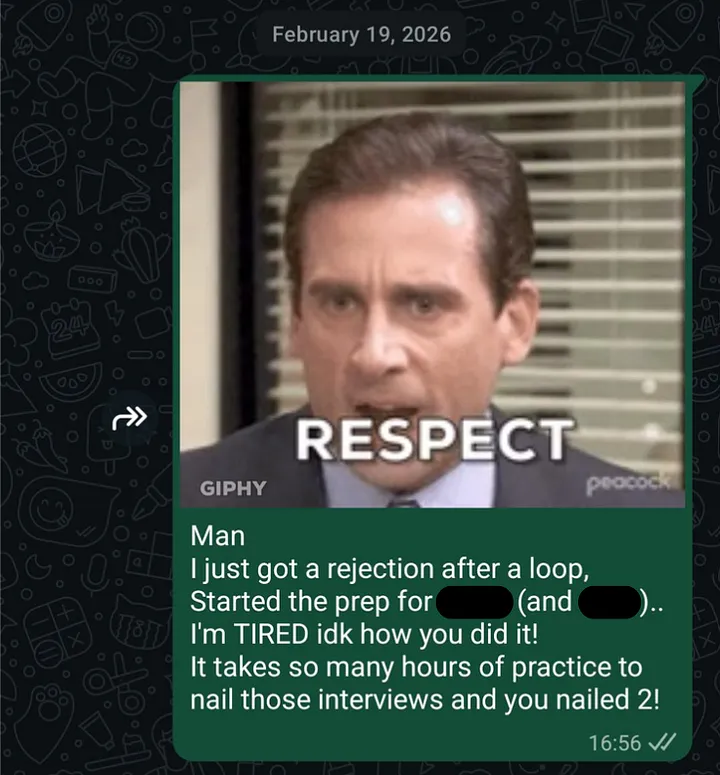
As you can see in the screenshot above, I had my fair share of frustration. If it’s any comfort, the process gets easier. At first, even a recruiter screen is high-stress. But after 10 interviews, you find your rhythm. You stop worrying about the “script” and start engaging in the conversation. By the end of my search, I was ending loops feeling energized instead of drained. Some were even… dare I say it? Fun.
Best of luck with your search!